· No need to remove rust. FERTAN® pulverises it and detaches it
·
· With FERTAN® rust is converted into an ideal paint base
·
· FERTAN® eliminates sanding, deep brushing, sandblasting
·
· The only sure, irreplaceable rust proofing system for new or old steel
structures
·
· Safe and easy to use, no isocyanates or flammable components
·
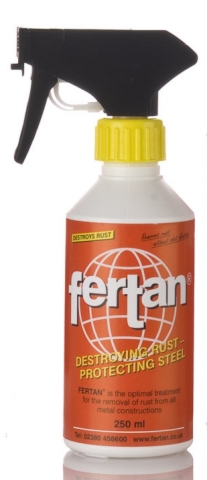
What is FERTAN®
Fertan is a patented product that pulverises rust and leaves an inert
layer of metal ready for painting. Once Fertan is applied clever chemistry
ensures that there are enough active ingredients to destroy the rust but
no more. As these get used up more are produced. Fertan doesn't attack
good metal, just the rust. During conversion loose rust is detached,
Fertan uncovers clean metal and creates a bonded film, protecting the
metal from possible future attack.
This film or coating is a bonded layer of non-rusting ferro-tannic
insoluble compounds . This surface is neutral and, once rinsed to remove
rust dust, is ready for painting.
Fertan may be applied to slightly rusty metal, hard rust, or bare metal to
protect it from future rust.
Fertan's aqueous solution penetrates everywhere, even through paint cracks
or panel joints.
It can be applied on damp or wet surfaces indoors or outdoors in any
weather conditions. Outside, avoid frost.
It is harmless to plastic, rubber, chrome and already painted surfaces.
FERTAN® is only active in contact with steel, iron or rust. It can be
washed off from any other surfaces with water.
Non-flammable, non-volatile, harmless to health either by physical contact
or fume inhalation.
FERTAN® provides long-term protection to iron and steel but the surface
should be painted within 6 months.
INSTRUCTIONS
Remove loose rust and scale if possible, why waste Fertan?
Apply FERTAN® with brush, roller, sponge or spray.
1 litre covers approximately 12 - 15 square metres (140 sq. ft) of
oxidised metal surface.
FERTAN® reacts well on wet surfaces and in damp/wet conditions. In dry
conditions wet the surface with a water spray. Most of the reaction takes
place within 24 hours but, if you can, wait 48 hours.
Check that the rust is completely converted to a black layer.
If not, insufficient was applied, so apply another coat to non black
areas.
Before painting the Fertanised surface remove the loose black dust (not
the hard layer) with water hose (large areas) or damp rag (small areas).
FERTAN® can by applied on any other rustproofing treatment and is
recommended for maintenance intervention on previously painted oxidises
areas.
On light paint colours, any spattering of FERTAN® should be washed off
within an hour of application.
SPECIFICATIONS & SAFETY PRECAUTIONS
FERTAN® is a dark liquid with a characteristic aromatic odour, very
slightly acidic, with a specific gravity of 1.18.
FERTAN® is non-poisonous, harmless, non-irritating for humans and
non-polluting for the environment.
In case of contact with skin, wash with plenty of running water. Eye
contact, wash with plenty of running water and consult medical
authorities. FERTAN® should not be consumed.
FERTAN® requires no particular safety precautions in storage. It is
sufficient to keep the container closed.
Shelf life in closed containers is practically unlimited.
Sedimentation does not normally occur during prolonged storage.
In case of leaking or breakage of containers it is recommended to dry with
sawdust and wash with water.
More technical information.
If you have a piece of rusty steel or iron there are two effective way to
treat it:
1) shotblast it to SA2½ in a low humidity atmosphere, treat it with blast
primer within 20 minutes and apply preservative coats within 2 hours
2) Paint it with Fertan in any conditions above freezing. Overcoat it
within six months.
Most rust removal products use high concentrations of phosphoric acid. If
the phosphoric acid is not completely consumed by its reaction with the
oxides on the surface being treated and the surface itself then it will
attack the metal and any other surfacing products that are applied. It is
obviously very difficult to calculate the amount of acid to apply as it
depends on the degree of rusting, the type of oxides present. So these
products need to be applied in excess. The treated surface should then be
power washed to remove all excess before applying finishing layers.
This is likely to remove the layer of tertiary iron phosphates that
provide the protection and allow water through to the surface of the
metal. But if it is not done then the acid remains to attack the finishing
coats.
Fertan works differently. It is composed principally of:
pyrogallic acid glucosides / ellagic acid glucosides (molecular weight 270
- 2000)
phosphoric acid
phosphates of bivalent transition metals such as Zinc and Manganese
Zinc and manganese nitrates.
Fertan, when taken from the container is a complex chemical solution which
is in an equilibrium state, meaning that it will not change until other
chemicals come into contact with it. It is so stable that it will remain
unchanging for twenty years. We have old samples that we test annually for
effeciveness.
Once iron oxides are detected the liquid uses up its initial tiny
percentage of phosphoric acid. Then it generates a tiny amount more. It
needs a tiny percentage of the acid to be stable. If that is used up by
attacking iron oxide then Fertan will generate more. The process is
repeated until no rust is left. So at no time is there a large quantity of
acid present.
If one looks at the treated surface all areas that had rust will be black.
This shows that sufficient Fertan was applied. If undamaged paint is
coated with Fertan the product remains as a dark brown liquid that should
be sponged or washed away.
As the rust is attacked it turns black. Some becomes loose dust to be
washed away. Some surface rust is neutralised and becomes bonded to the
surface. There it forms a part of the layer of insoluble chelate that
covers the treated area. This chelate continues to protect the surface
from the atmosphere and provides a non rusting surface that can be
overcoated with any finishing systems. Fertan may be coated with any
finishing system no matter how simple or complex.
Any Fertan that is not used up attacking rust bonds to the metal's
surface. It remains dormant there for years until the paint surface above
it is is damaged. If the impact or scratch that caused this goes through
to the metal surface it will start to rust. As that rust reaches the
Fertan it will become active and limit the damage to the initial scratch,
minimising the repair work necessary.
Fertan takes time to work. Twelve hours is good, a full day is better. It
is working to change the structure of the materials surface and the
reaction just takes that amount of time. We can make it go faster but the
results are not perfect. Imperfection is useless with this sort of
product. We all want long lasting perfect, unblemished surfaces.
The full description of what happens as Fertan returns metal to a
paintable surface runs to some ten pages and the above is intended to
provide one level of information more than the simple leaflet. If you are
a chemist or just have a strong desire to know the details please let me
know and I'll post or, preferably, email a copy of one of the patents to
you.
Fertan works superbly. People who use it do not change to other products.
It complements any paint range as it provides a good base for that paint
to be applied to.
Fertan
is available in the following options:
|